Man with a Movie Camera
He's talkin' to you? Loud and clear.

Martin Scorsese has been making films (if we include his student work) for well over six decades. His films have been discussed, imitated, revered, and condemned. The director himself has become something of a celebrity, appearing in television commercials (he’s directed several), in his own films, and as an actor in works as varied as Akira Kurosawa’s “Dreams”, Albert Brooks’ “The Muse”, and the forgettable animated film “Shark Tale”. More recently, he’s become, at the urging of his daughter Francesca, a frequent presence on TikTok. Whether passionately discussing his own work or feverishly endorsing films he loves, Scorsese is no wallflower. He’s the Saint Paul of motion pictures.
If you’ve followed Scorsese’s career or read any of the dozens of books about the director and his work (my far-from-exhaustive shelf holds nine volumes), there are few surprises to be found in Rebecca Miller’s documentary series “Mr. Scorsese” (currently on Apple TV), but that doesn’t diminish its interest in the least. At the age of 82 (he’ll turn 83 later this month), and with more than thirty features and documentaries already under his belt, he remains as enthusiastic about the medium he’s embraced as ever. “Mr. Scorsese” gives him time to retrace his creative steps, analyze the commercial ups and downs of his career, and still leave the viewer wishing for another hour or two.
Miller speaks to many of the performers, writers, industry contemporaries and family members who can provide insight into the director’s long career, offers extensive excerpts from most of his work from early shorts to “Killers of the Flower Moon” (although some of his documentary work is unfortunately ignored – no mention of such worthy titles as “No Direction Home”, “Personality Crisis”, Rolling Thunder Review”, “Public Speaking”, or “The 50 Year Argument”,) and devotes significant time to his family life, but what she doesn’t do, admirably, is pretend there’s an overreaching arc that makes sense of his six decades of creative life. It’s a biography without an agenda and is all the better for it. Part of the justification for the series’ length is that it allows our understanding of Scorsese to unfold and grow, to evolve rather than conform to an awkwardly forced narrative arc. That’s a large part of what makes “Mr. Scorsese” so enlightening, even for viewers who have been tracking his work for years.
But there is a story here, subtly woven throughout the five episodes and 285 minutes. It’s a Scorsese greatest hits collection, but its playlist forms a parallel history of American filmmaking from the waning days of the studio system to the franchise-heavy and distribution-fragmented state of filmmaking today. He began making movies at a time when New Yorkers like John Cassavetes, Shirley Clarke and Robert Frank had launched a take-it-to-the-streets mode of filming that wasn’t quite underground but definitely stayed shy of Hollywood. After years of teaching film, grabbing odd jobs as editor or cameraman, and going through what would eventually be recognized as a New Hollywood rite of passage – making an exploitation movie for Roger Corman – before finally getting to make what would become his breakthrough, the flashy, rule-bending “Mean Streets”, combining autobiographical stories with a relentless New Wave-inspired energy.
It was a time – a relatively small window, as it turned out – when young directors (and a few older ones like Robert Altman and Arthur Penn) who grew up loving the language of film and understanding its history found an audience – after the surprising and studio-worrying triumphs of “Easy Rider”, “Bonnie and Clyde” and “The Graduate” -equally excited by the possibilities of the medium and less inclined to show respect to the flailing efforts of the flagging studio system. Scorsese was one of a small network of aspiring filmmakers – friends and colleagues Brian DePalma and Paul Schrader among them - fighting to get their foot in the production door.
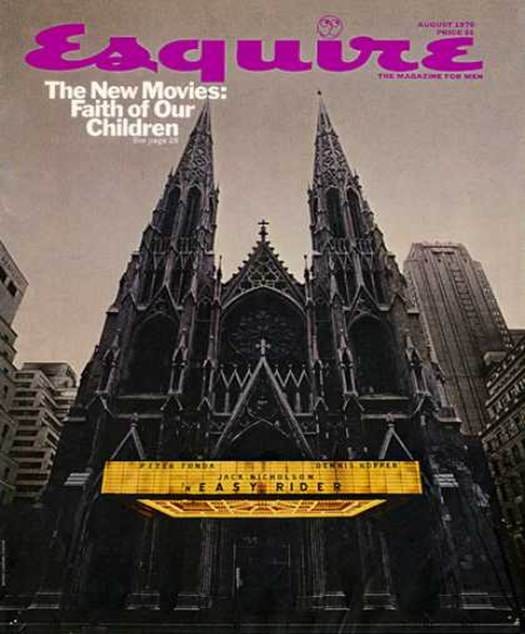
And for a brief time, it worked. Less a movement than a demographic, the “New Hollywood”, “New American Cinema”, - whatever you want to call it – gave American film a relevance and cultural cachet it had been missing for half a century. Dennis Hopper and Jack Nicholson made the covers, respectively, of “Life” and “Newsweek”, while “Esquire” created a typically ingenious cover showing just what place in our culture had been usurped by contemporary films:
But it couldn’t last. At the same time that movies like “Mean Streets”, “Sisters”, “Badlands”, and “McCabe and Mrs. Miller” were expanding the possibilities of the medium, something else was expanding, too. In 1972, “The Godfather” (directed by Francis Ford Coppola, who had a foot in both Old and New Hollywood) became the highest-grossing film of all time, a record that had never seemed particularly important in earlier times. A year later, the record was broken again by “The Exorcist”. Two years later, “Jaws” made enough money to make those earlier record-breakers seem trivial. Suddenly, discussion about movies in the popular press became all about dollar figures. Outlets that didn’t carry film reviews began reporting weekend box offices grosses. Film advertising became more likely to skip critic’s quotes and get straight to the point, touting “The No. 1 movie in America!” as a selling point.
It is not unusual to hear it said films like “Taxi Driver” or “Nashville” or “Days of Heaven” “couldn’t be made today”. In Miller’s film, Scorsese suggests that he sensed a change in the filmmaking climate as soon as he saw the lines for “Jaws”. It’s even more ironic to hear Steven Spielberg himself, a director with a slightly similar background to many of the New Hollywood names but far more willing to shepherd films back into safe, conservative, and box-office-friendly territory, admit that his film was the end of an era for more ambitious or less intellectually timid filmmakers like Scorsese.
It’s a small concession, even one that can be overlooked, but it makes “Mr. Scorsese” into more than just a string of “And then I directed…” anecdotes. Scorsese is a Homeric hero, an Odysseus struggling not just to keep his crew alive and get back to Penelope, but to keep making films that reflect his own ambitions and inner turmoil while facing a constantly shifting string of foes and inhuman forces. That’s part of the appeal of this series and what makes it more than just an anecdotal meandering through more than a half-century of filmmaking. He’s fought studios, battled censorship campaigns, struggled to complete ambitious personal projects, and fostered unique partnerships (ten films with Robert DeNiro, six with Leonardo DiCaprio). “Mr. Scorsese” is not the last word, but it’s a fine place to stop and take stock of an ambitious and innovative filmmaker, still fighting, still making his way to a cinematic Ithaca.
(“Mr. Scorsese” is currently showing on Apple+. Ask someone for their password.)